



Key takeaways
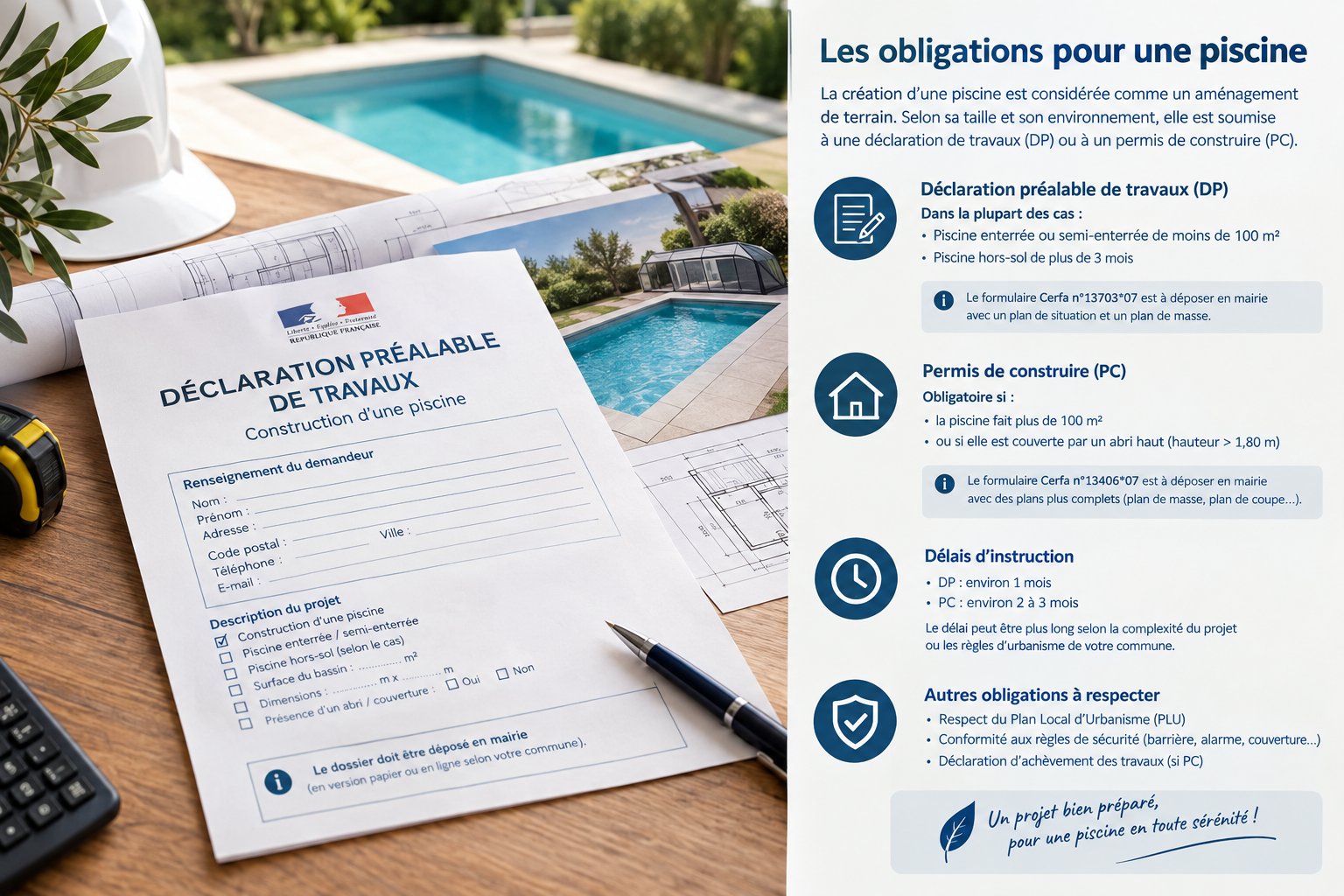
- Depending on its area and cover, a pool may require no formality, a prior declaration or a building permit.
- In general: no formality up to 10 m², a prior declaration from over 10 to 100 m², and a building permit above 100 m².
- The municipality's PLU and protected areas may change these rules.
- Preparing the file can be partly automated, but obligations must still be checked.
Building a pool is not just about choosing its shape, dimensions and finish. Depending on the project, planning permission may be required before work begins.
For homeowners and pool professionals alike, it is essential to know when a prior declaration is required, which steps to take and which documents to prepare. Here are the main rules to know in 2026.
🏊 Does a pool need to be declared?
The answer mainly depends on the pool area, its cover and the location of the project. Outside areas subject to specific rules, the French Planning Code provides in particular that pools with a surface area of 100 m² or less require a prior declaration when they are uncovered or when their cover is less than 1.80 m high.
The main cases to remember
| Project | Formality generally required |
|---|---|
| Pool up to 10 m² | No formality in general |
| Pool from over 10 m² to 100 m² | Prior declaration |
| Pool over 100 m² | Building permit |
| Covered pool with a cover over 1.80 m high | Building permit in the cases set out in the Code |
| Pool located in a protected area | Specific rules may apply |
⚠️ This table shows the main general cases. The municipality's PLU, the plot's situation or its classification in a protected area may change the procedures required.
📐 Pool area is not the only criterion
It would be tempting to think that only the size of the pool determines the permission required. In reality, several factors may come into play:
- the pool area;
- whether or not there is a cover;
- the height of the cover;
- the location of the plot;
- the PLU rules;
- whether the plot is in a protected area;
- the features of any landscaping associated with the project.
Pools located in remarkable heritage sites, near historic monuments or in certain listed sites may be subject to special provisions.
Before taking any steps, it is therefore important to check the rules that apply to the plot.
📝 How do you make a prior declaration for a pool?
When the project requires a prior declaration, the file must be prepared before work begins. The prior declaration allows the town hall to check that the project complies with the applicable planning rules.
The file may require:
- the corresponding administrative form;
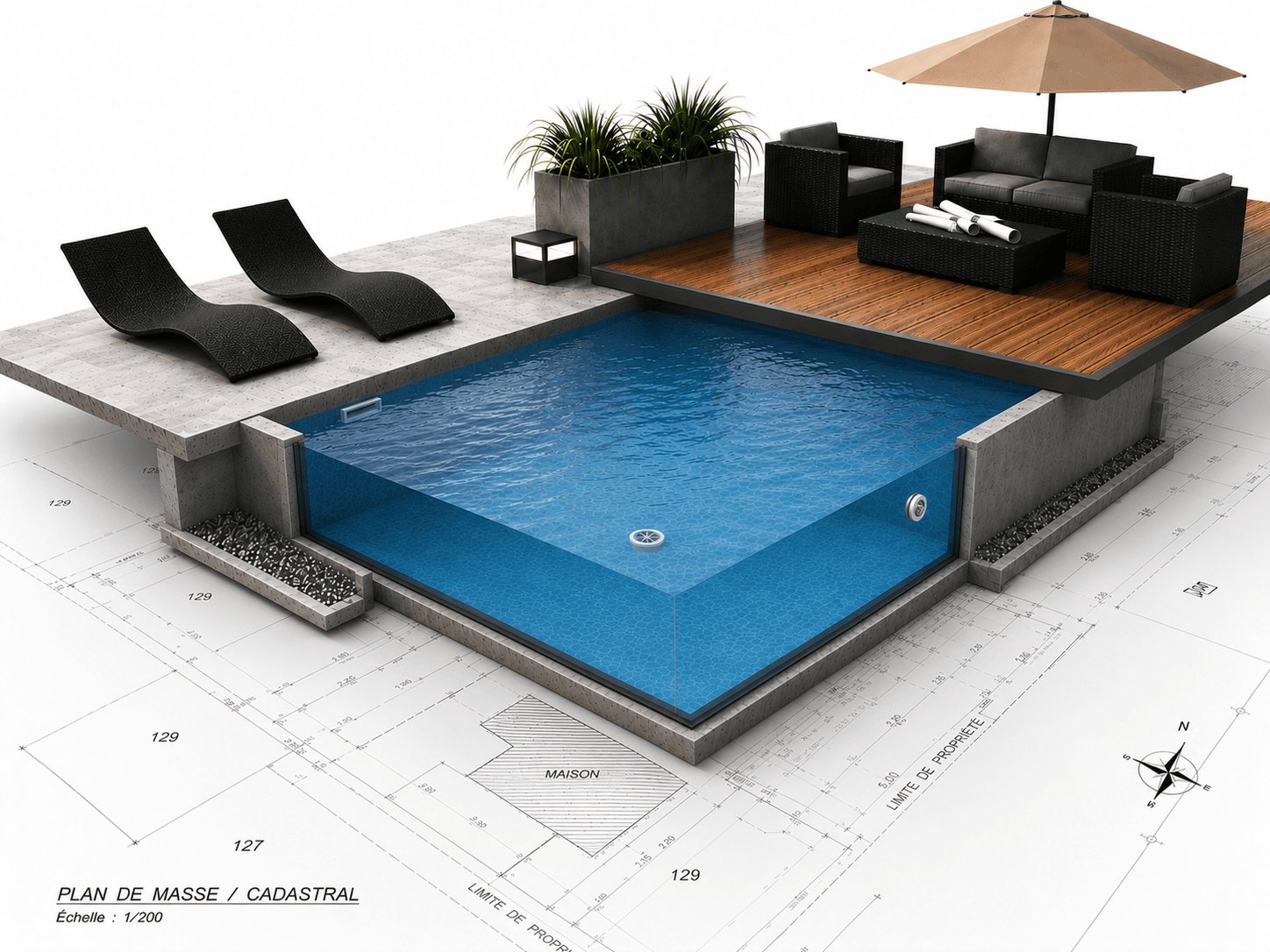
- a site location plan;
- a site plan;
- a representation of the current and future state of the plot;
- graphic documents showing the project;
- photographs of the near and far surroundings;
- as well as any additional documents required depending on the nature and location of the project.
The exact content of the file depends on the project.
🏡 Why is the PLU so important?
Even when a pool seems to fall into a clearly defined category, the project must also comply with local planning rules. The PLU may regulate in particular:
- where the pool is located;
- distances from property boundaries;
- rules concerning existing buildings;
- external appearance;
- certain related landscaping;
- and the areas where specific rules apply.
Two pool projects of identical size may be subject to different constraints depending on their municipality.
⏱️ Paperwork that can quickly become time-consuming
For a pool builder, the prior declaration is an extra step in the sales process. After you:
Advise the client → Design the pool → Prepare the quote → Get the signature
… you still need to prepare the administrative file. And when a company handles several projects a week, the repetitive tasks pile up:
- ✕Find the plot information
- ✕Enter the dimensions
- ✕Prepare the plans
- ✕Create representations of the project
- ✕Produce the required documents
- ✕Check the information
- ✕Put the file together
All time that could be spent on your clients and job sites.
🤖 Can the preparation of declarations be automated?
This is exactly where digital tools can add real value. With a trade solution such as Logyline Studio, the information used to design the project can be reused to help prepare the administrative documents.
No more entering the same information several times.
The dimensions, location and representations of the project can serve as the basis for the required documents, depending on the features of the solution and the characteristics of the project.
⚠️ Automating does not mean forgetting obligations
Automation helps you save time, but it does not exempt the professional from checking the rules that apply to the project. The PLU, protected areas and the specific characteristics of the plot may affect the procedures.
It is therefore essential to check the file before submitting it. The software becomes an assistant for preparing the file, while validation remains the responsibility of the professional and the applicant.
📅 And after permission is granted?
The paperwork does not necessarily end once permission is obtained. Once the work is completed, other formalities may be required, in particular the declaration certifying completion and compliance of the work (DAACT) where the project requires it.
Professionals therefore have every interest in including the administrative side in their overall project management process.
🚀 Planning applications: a constraint that can become a time saver
Centralising project information, automating repetitive tasks and generating the required documents faster streamlines the journey, from sale to job site.
With Logyline Studio, the aim is to bring together:
Design → Sale → Declaration → Preparation → Job site
Less re-entry. Fewer repetitive tasks.
More time for your clients.
📌 Key points - Before starting work
- ✔Check the pool area
- ✔Check the features of any cover
- ✔Consult the planning rules that apply to the plot
- ✔Check the municipality's PLU
- ✔Find out whether the plot is in a protected area
- ✔Determine the planning permission required
- ✔Prepare all the documents for the file
- ✔Complete any formalities required after the work
Regulations change and every project has its own specific features: if in doubt, contact the town hall or the relevant planning department.
Frequently asked questions
Does a pool need to be declared?
In general, no formality is required up to 10 m². A prior declaration is required from over 10 m² to 100 m², and a building permit above 100 m².
Does a covered pool require a building permit?
If the cover is more than 1.80 m high, a building permit may be required in the cases set out in the French Planning Code.
Why check the local urban plan (PLU) before a pool project?
The PLU may set rules specific to the municipality and change the procedures required. If in doubt, contact the town hall.
Can the preparation of a prior declaration be automated?
Partly: software like Logyline Studio prepares elements of the file from the project. The professional must always check the rules that apply to the plot.